Vehicle Inspection Lines
Automatic Vehicle Safety Inspection Line
A computer-centered inspection line for safety inspection data acquisition, processing, display, and reporting.
- Computer-centered data acquisition, processing, display, and reporting
- Automatic scheduling across inspection stages
- Distributed network support for multiple lines and stations

Requirements and system scope
- The inspection organization holds legal-person status and a valid measurement-certification certificate.
- The station provides the equipment and calibration equipment required for its declared vehicle types and inspection items, including sideslip, lighting, axle load, braking, emissions, noise, and speed.
- The organization has an adequate number of qualified vehicle safety inspectors and the required special-inspection authorization.
- Complete operating management systems, vehicle safety inspection standards, procedures, and technical documentation are maintained.
- Vehicle safety inspection equipment has valid legal approval, and in-service measuring instruments remain within authorized verification periods.
- The station has facilities for connection with vehicle-administration or technical-quality-supervision information systems.
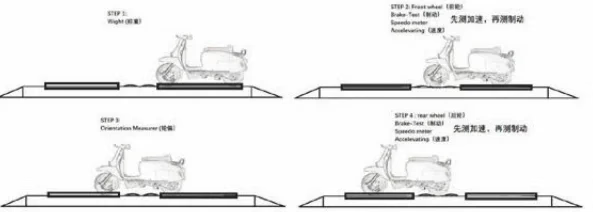
Inspection chain
The line centers data acquisition, processing, display, and reporting in a coordinated inspection workflow.
Station layouts and configurations can be selected for vehicle type, inspection scope, and local operating requirements.
System features
- Advanced, practical workstation layouts with computer-centered acquisition, processing, display, and reporting
- Intelligent fully automatic inspection with out-of-sequence registration, inspection, and scheduling
- Expandable distributed network architecture for multiple lines and multiple workstations
- System self-control functions with real-time remote maintenance and convenient server-based upgrades
- Simple, accurate calibration and integrated welded benches that need no anchor bolts
Technical specifications
| Parameter | Description |
|---|---|
| Measured gases | Carbon monoxide (CO), hydrocarbons (HC), carbon dioxide (CO2), oxygen (O2), nitrogen oxides (NOx), and lambda value |
| Measurement technology | NDIR for CO, HC, and CO2; electrochemical measurement for O2 and NOx |
| OBD function | Supports J1979 and CAN bus communication |
| Data output | RS232, Bluetooth, Wi-Fi, with optional cloud upload |
| Standards compliance | CE, RoHS, US EPA, and Euro 6 requirements |
| MOQ and delivery | Confirmed for each project configuration |
| Customization | OEM identification and customized report formats |
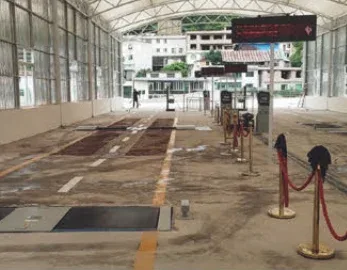
Layout and installation
Frequently Asked Questions
Technical questions to resolve before planning
01Does the test bench require anchor bolts for heavy trucks?
No. The integrated welded bench uses its own mass, anti-slip pads, and limit blocks to resist normal vehicle forces. Install it on a level hardened C30 concrete floor at least 200 mm thick.
02Can the system handle out-of-sequence vehicles and retests?
Yes. It recognizes the vehicle plate or RFID tag, schedules an available station for a returned vehicle, and matches the inspection flow and items to the applicable standard.
03Can the software be restored after a control computer is replaced?
Yes. The distributed architecture normally licenses software through a hardware key or server rather than one computer. Install the client, connect the key, and configure the server IP; retain regular industrial-PC configuration backups.
04How can remote maintenance work on an internal network without a public IP?
Remote assistance can use a VPN or a secure remote-access tool. The industrial PC needs internet access directly or through a station computer proxy; the maintenance module supports communication and software-setting diagnostics.
05What makes calibration simple and reliable for stations without specialist metrology staff?
Each bench uses guided calibration steps. The operator follows prompts to load the standard force or sideslip tool and lets the software calculate correction factors, so trained operators can complete the work without adjusting potentiometers or low-level code.
Related Products
Compare related inspection systems
Request a Quote
Request configuration and pricing for your project.
Share your country or region, vehicle type, inspection items, target throughput, and current project stage.
Share the project location, vehicle types, inspection scope, applicable standards, target throughput, site conditions and current stage. We will confirm the configuration scope before discussing pricing.