
Insights
What Are the Two Main Types of Brake Testers?
An introduction to roller brake testers and flat-plate brake testers, and how each simulates road surfaces to capture braking data.
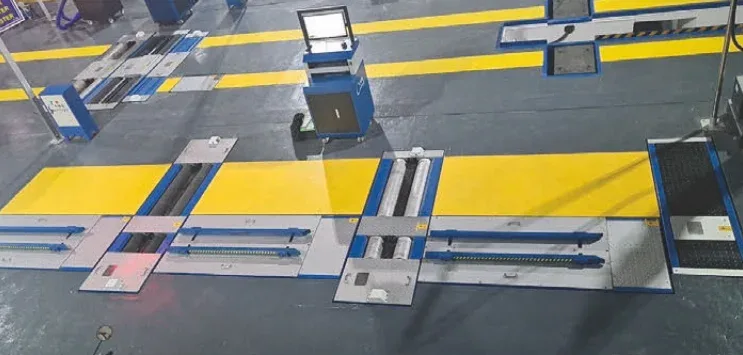
Roller brake testers
A roller brake tester supports the wheels on a pair of rollers driven by an electric motor, simulating the vehicle running on the road. When the driver applies the brakes on the rollers, the machine measures the braking force and balance of each wheel to evaluate the vehicle's braking performance.
This construction suits continuous work on an inspection line: the vehicle simply stops between the rollers and the test completes without moving around the site, making it the most common form of brake testing on safety inspection lines.
Flat-plate brake testers
A flat-plate brake tester replaces the rollers with a low-friction plate. The vehicle drives slowly onto the plate and brakes, while sensors beneath the plate measure the forces between wheel and plate during braking, producing braking force and balance data.
The plate construction is simple, needs little installation space, and combines easily with sideslip and axle-load checks on the same frame.
Choosing between the two
Both machines capture braking data by simulating the road surface; they differ in test form and site requirements. Roller testers suit high-throughput continuous testing on fixed lines, while plate testers fit constrained sites or combined inspection setups. The choice should follow the vehicle mix, daily volume, and site conditions.